
The Complete Guide to Dementia and Alzheimer’s Care at Home
Alzheimer’s and dementia care tends to follow a recognizable path — home-based assistance first, then memory care or hospice as the disease progresses. Each stage brings new demands: more structure, more support, and higher costs. This guide is designed to help families understand what’s ahead and feel more prepared to meet it.
This guide covers what you and your loved one can expect: how dementia affects the mind and body, what in-home care looks like at each stage, how families can best show up, and the financial and legal steps that are too often overlooked entirely.
One thing almost nobody mentions at diagnosis: legal capacity disappears as cognition declines. Power of attorney, advance directives, Medi-Cal planning — all of it must be established while your loved one can still sign. Most families miss this window completely.
And this: caregiver stress is clinically linked to faster patient decline. Your well-being isn’t a luxury — it’s part of their care plan.
Key Takeaways
- Dementia care evolves at every stage — your care plan must evolve with it
- Legal and financial planning must happen at diagnosis, not after
- Consistent in-home care delays memory care placement — often by years
- Caregiver burnout is a clinical risk for the patient, not just the caregiver
Alzheimer’s vs. Dementia — Why Everyone Gets This Wrong
The confusion is understandable. Alzheimer’s is a type of dementia, just as a golden retriever is a type of dog. Every Alzheimer’s patient has dementia, but not every dementia patient has Alzheimer’s. Doctors often use both terms in the same conversation without pausing to explain the difference.
They look similar because they cause the same visible problems: memory loss, confusion about time and place, trouble with daily tasks, personality changes, and difficulty communicating. Same symptoms. Different diseases. Different care needs.
There are five main types of dementia — and the type changes everything about how you care for someone:
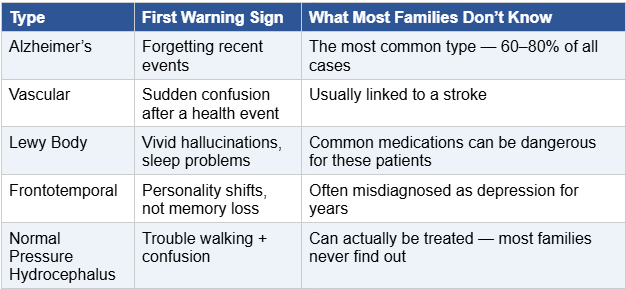
Lewy Body patients are sometimes given common medications to control hallucinations. In these patients, those same medications can cause severe, life-threatening reactions — and families are almost never warned about this.
Normal Pressure Hydrocephalus is not caused by brain deterioration — it’s caused by a buildup of fluid. It can look exactly like dementia. It is frequently misdiagnosed. And in many cases, a straightforward procedure can resolve it. Many families spend years caregiving for a condition that was treatable.
If your loved one’s doctor said “dementia” without specifying which type, that’s not enough information. Ask directly. The type determines which medications are safe, how to structure the daily routine, and how caregivers should communicate with your loved one. What works for Alzheimer’s can actually make frontotemporal dementia worse.
Still in the early stages? Learn the early warning signs here — and if prevention matters to your family, these 10 foods are clinically linked to lower dementia risk.
The Stages of Dementia — What It Actually Looks Like at Home
Most guides describe dementia stages in clinical language. What families really need is a picture of what each stage looks like inside the home, on an ordinary day, with a real person.
Early Stage — The Stage Most Families Deny
The person seems mostly fine. They repeat questions. They misplace things. They get frustrated more easily than usual. It’s easy to explain it away as stress or normal aging — and many families do. But this is the most important stage to take seriously, not because the symptoms are severe, but because this is when legal and financial planning must happen. Once this window closes, it doesn’t reopen.
At home, this looks like: forgetting recent conversations, missing appointments, struggling with finances, and withdrawing from hobbies.
Care needed: light supervision, routine structure, medication reminders, and safety checks.
Middle Stage — When Home Care Becomes Essential
This is both the longest stage and the hardest on families. Your loved one will need help with dressing, bathing, and eating. They may not recognize close family members. Wandering can begin. Sleep becomes disrupted. Behavioral changes — agitation, suspicion, repetitive behaviors — can appear without obvious warning.
At home, this looks like: getting dressed takes an hour, nights are restless, familiar people feel like strangers, and the same question gets asked forty times before noon.
This is the stage where a consistent in-home caregiver makes the most measurable difference. Research published by the Alzheimer’s Association shows that structured routines and familiar environments reduce behavioral symptoms in middle-stage dementia patients — including agitation, wandering, and sleep disruption.
Care needed: hands-on daily assistance, structured routine, professional in-home dementia care, and regular respite for family caregivers.
Late Stage — Comfort Over Everything
Your loved one will likely be largely non-verbal. They’ll need full assistance with every daily function. The focus shifts entirely to comfort, dignity, and pain management. This is when families face one of the hardest decisions: home-based hospice care or a memory care facility.
At home, this looks like: total physical dependence, minimal verbal communication, difficulty swallowing, and sleeping most of the day.
Care needed: hospice support, full-time professional care, and emotional support for the whole family.
The transition between stages rarely announces itself. There’s no clear line. Most families adjust their care plan only after a crisis — a fall, a wandering incident, a hospitalization. By then, the damage is often done. Reviewing the care plan at every visible stage change — rather than waiting for an emergency — is what keeps patients stable and families in control.
What Dementia Does to the Body — Not Just the Memory
Families brace themselves for memory loss. What they often don’t prepare for is everything else. Dementia affects nearly every system in the body, and the symptoms that catch families most off guard have nothing to do with forgetting names.
Sleep: The brain’s internal clock breaks down. Many patients are awake through the night and exhausted during the day. This alone is one of the primary reasons family caregivers burn out.
Eating: Dementia patients can forget they’re hungry. They may lose the ability to recognize food, chew safely, or swallow without risk. Malnutrition and dehydration are common and frequently missed. Nutrition in seniors with dementia requires a thoughtful, specific approach — not just a balanced meal.
Pain perception: This is one of the things most families never hear: dementia patients often lose the ability to communicate pain — not always to feel it. They may experience real discomfort but be unable to locate it, describe it, or ask for help. A urinary tract infection, a fracture, an internal injury — all can go undetected. Sudden behavioral changes in dementia patients are frequently a sign of undiagnosed pain. Always rule out physical causes before assuming a problem is behavioral.
Vision and hearing: The brain loses its ability to correctly process what the eyes and ears send. Your loved one may see things that aren’t there, misinterpret shadows, or stop responding to voices — not because of hearing loss, but because the brain isn’t processing sound correctly. Untreated hearing loss forces the brain to work harder, a cognitive load that research links to faster dementia progression. Addressing hearing decline early is one of the few modifiable risk factors families can actually act on.
Emotional regulation: The brain’s filter breaks down. Anger, fear, and sadness can surface without warning or an obvious trigger. This is neurological, not personal.
Immune system: In late-stage dementia, the body’s ability to fight infection weakens significantly. Pneumonia and urinary tract infections are the leading causes of death in late-stage dementia patients — not the disease itself.
Behavioral changes are almost always a symptom of something physical — pain, infection, hunger, or overstimulation. Before assuming agitation is psychological, check physical causes first. A trained in-home caregiver knows what to look for. A family member who has been caregiving for months, often without a break, may not notice — and that’s not a failure, it’s a human limitation. Here’s what to watch for with hearing and sensory decline.
In-Home Alzheimer’s Care — What a Professional Caregiver Actually Does
Most families picture in-home dementia care as help with bathing and meals. That’s part of it. But professional in-home Alzheimer’s care is built on four clinical pillars — and when any one of them is missing, the entire care plan can destabilize.
1. Routine Structure in Dementia Home Care
For dementia and Alzheimer’s patients, the daily routine isn’t just a schedule — it is the treatment. A consistent sequence of waking, eating, activities, and rest reduces anxiety, minimizes confusion, and directly lowers agitation. Research shows that structured routines reduce behavioral symptoms more consistently than medication adjustments alone. Disrupting that routine — a hospital visit, a substitute caregiver, a holiday — can produce real behavioral decline. A professional dementia caregiver protects the routine as a clinical priority, not a personal preference.
2. Personal Care and Safety in Alzheimer’s Home Care
In-home Alzheimer’s care covers the daily tasks your loved one can no longer manage safely on their own: bathing, dressing, medication reminders, fall prevention, and nutrition monitoring. But the safety component goes deeper than task completion. A trained dementia caregiver recognizes the early physical signs that something is wrong — changes in appetite, unusual quietness, restlessness — before they escalate. Knowing what to watch for at each stage is what separates professional dementia care from basic supervision.
3. Cognitive Engagement in Senior Dementia Care
Senior dementia care is not passive. Music, familiar objects, simple conversations, and sensory activities aren’t entertainment — they’re evidence-based tools that slow cognitive decline and reduce behavioral symptoms. A professional in-home caregiver integrates cognitive engagement into daily care naturally, without forcing it. Music therapy specifically benefits Alzheimer’s patients in ways most families never think to use — it’s one of the most accessible tools available.
4. Family Communication in Dementia Caregiver Support
A professional dementia caregiver is the family’s eyes inside the home. Daily updates, observations about stage changes, medication concerns — consistent communication between the caregiver and the family is what allows the care plan to evolve before a crisis forces it. This is the pillar most often overlooked when families hire independent caregivers without agency support.
What in-home Alzheimer’s care is not: a replacement for the family. It’s the support structure that allows the family to remain present — without burning out in the process.
Tips for Caring for Someone with Dementia at Home
Most caregiving advice is too vague to actually use. “Be patient.” “Keep a routine.” “Stay calm.” Families already know this. What helps is the specific technique behind each principle — and why it works.
- Never say “don’t you remember?” This is the single most common mistake family caregivers make. Asking a dementia patient to remember forces their brain to confront its own failure — triggering shame, frustration, and agitation in seconds. It achieves nothing clinically and causes real emotional distress. Instead, provide the information directly: “We’re having lunch now,” not “Don’t you remember? We eat at noon.”
- Never argue with their reality. If your loved one believes it’s 1975, arguing doesn’t correct them — it frightens them. Their brain is living in a real experience. The clinical approach is validation therapy: enter their reality, acknowledge their feelings, and gently redirect. The Alzheimer’s Association documents this as one of the most effective tools for reducing agitation in dementia patients.
- Use one sentence at a time. Dementia progressively reduces the brain’s ability to process multiple pieces of information at once. Long sentences, complex questions, and multiple choices create cognitive overload that shows up as confusion or refusal. One sentence. One question. One instruction. Wait for a response before continuing.
- Ask questions with two options at most. “What do you want for breakfast?” is unanswerable for a mid-stage dementia patient. “Would you like eggs or toast?” is manageable. The brain can still choose between two familiar options long after open-ended decision-making becomes impossible. This single adjustment can dramatically reduce mealtime resistance.
- Control the environment, not the person. Agitation in dementia patients is almost always triggered by something external — noise, clutter, unfamiliar faces, poor lighting, or temperature. Before trying to calm an agitated patient, scan the environment first. Reducing sensory overload works faster and longer than any verbal intervention.
- Never rush personal care. Bathing and dressing are the most common triggers for resistance and aggression in dementia patients — not because the person is being difficult, but because they don’t understand what’s happening to their body. Narrate every step before it happens. “I’m going to help you wash your arm now.” This reduces the startle response and builds momentary trust.
- Match your energy, not just your words. Dementia patients lose language long before they lose emotional perception. They may not be able to process what you say — but they read your body language, tone, and facial expression with precision. A caregiver who is rushed or tense transmits that directly to the patient. Slowing down physically — not just verbally — is one of the most undertrained skills in professional dementia home care.
How to Choose the Right In-Home Dementia Caregiver
Choosing an in-home Alzheimer’s caregiver is one of the most important decisions a family will make — and most families make it under pressure, after a crisis, without knowing what to look for. The result is often a poor fit, a failing care plan, and starting over within months.
Here’s exactly what to evaluate before hiring anyone for in-home dementia care:
- Dementia-specific training — not just general senior care. General home care training and dementia care training are not the same thing. A caregiver who excels with post-surgery recovery or chronic conditions may have no framework for managing dementia behavior, communication decline, or stage transitions. Ask specifically: what dementia-specific training has this caregiver completed? Alzheimer’s care requires a distinct skill set — validation techniques, routine management, behavioral recognition. If the agency can’t answer that question specifically, that is your answer.
- Caregiver consistency — the most underrated factor. In in-home Alzheimer’s care, the caregiver is the treatment. Rotating caregivers — even highly qualified ones — destabilize dementia patients. Every new face resets trust, disrupts the routine, and triggers anxiety. Before hiring a home care agency for dementia care, ask directly: what is your caregiver consistency policy? How do you handle substitute caregivers? A good dementia care agency treats consistency as a clinical standard, not a preference.
- Experience with behavioral symptoms. Agitation, wandering, sundowning, refusal of care — these aren’t occasional problems in dementia caregiving. They’re daily realities in the middle and late stages. A qualified in-home dementia caregiver doesn’t just manage these moments — they anticipate and prevent them. Ask for specific examples of how the caregiver has handled behavioral episodes. Vague answers signal inexperience.
- Family communication standards. Professional in-home Alzheimer’s care should include the family, not just the patient. A qualified dementia caregiver provides regular updates on behavioral changes, physical symptoms, and stage progression — giving families the information they need to make decisions before a crisis forces them. Ask how the agency communicates with families. Daily updates or a structured reporting system is the standard you should expect.
- Agency support vs. independent caregiver. Families sometimes consider hiring an independent caregiver to reduce costs. The risk: no backup when the caregiver is sick, no oversight, no training standards, and full legal liability on the family. A licensed home care agency carries insurance, provides substitute caregivers, supervises care quality, and maintains compliance. For dementia care specifically — where consistency and training are clinical requirements — agency support isn’t a luxury. Understanding the difference between care options is essential before making this decision.
The question most families never ask: “What happens when my loved one’s dementia progresses to the next stage? Can your caregivers handle late-stage care? Will the care plan evolve?” A good dementia home care agency will have a clear, honest answer for all three.
What the right in-home dementia caregiver looks like: dementia-trained, consistent, experienced with behavioral symptoms, communicative with the family, and backed by a licensed home care agency that plans for every stage of the disease.
At Allure Home Care in New York City — and now Boston — every dementia caregiver is trained specifically in Alzheimer’s and dementia care, assigned consistently to the same client, and supported by a care team that communicates with your family at every stage. If you’re looking for in-home Alzheimer’s care in New York City, Boston, or the surrounding areas, we’re here to help.
When Family Members Provide Dementia and Alzheimer’s Care
Every day across the United States, thousands of family members — daughters, sons, spouses — wake up and provide full-time dementia care with no training, no breaks, and no end date in sight. They don’t call themselves caregivers. They call themselves family. And that distinction is often exactly why they never ask for help until they’re already in crisis.
1. The Health Risk of Family Dementia Caregiving
Family members providing in-home dementia care aren’t just exhausted — they are clinically at risk. Research published in the Journal of the American Medical Association found that family members caring for a spouse with dementia had a 63% higher risk of developing dementia themselves. A separate study found that family dementia caregivers experience significantly higher rates of depression, anxiety, and cardiovascular disease than their non-caregiving peers — and that their own health declines in direct proportion to their loved one’s disease progression.
This isn’t burnout. It’s a documented health crisis that develops quietly while the family member’s attention is somewhere else entirely.
2. How In-Home Dementia Care Affects Family Health
- Sleep deprivation is cumulative. Nighttime wandering, disrupted sleep, and constant hypervigilance accumulate over months into a level of cognitive impairment that can mirror mild dementia itself.
- Chronic stress physically damages the immune system. Family members providing Alzheimer’s home care report significantly more illness, slower recovery, and higher rates of hypertension.
- Isolation compounds everything. The social withdrawal that comes with full-time in-home dementia care is one of the strongest predictors of depression in family caregivers.
- Guilt prevents help-seeking. Many family members delay getting professional dementia care support — not because they can’t afford it, but because asking for help feels like failure.
3. Family Caregiver Health Directly Affects Patient Outcomes
When a family member providing dementia care begins to deteriorate — physically, mentally, emotionally — the dementia patient often deteriorates with them. The quality of in-home Alzheimer’s care is directly tied to the health of the person providing it. This isn’t a moral argument. It’s a clinical one. Ignoring your own well-being while caring for someone else isn’t sustainable — and it ultimately doesn’t serve them either.
4. When to Bring in Professional In-Home Alzheimer’s Care Support
The families who sustain in-home dementia care the longest aren’t the ones who do everything themselves. They’re the ones who brought in professional Alzheimer’s home care support early — preserving their own health, their relationship with their loved one, and the quality of care their loved one actually receives.
Professional in-home dementia care isn’t a replacement for family. It’s what makes it possible for the family to still be present — emotionally, not just physically — at every stage of the disease.
5. Practical Tips for Family Members Providing Dementia Care at Home
- Set a non-negotiable daily break. Even 30 minutes outside the house, alone, can reset the nervous system. It’s not selfish. It’s maintenance.
- Accept help before you need it. Waiting until crisis to bring in support makes the transition harder for everyone — including the dementia patient.
- Tell your doctor what you’re doing. Family members providing in-home Alzheimer’s care should tell their own physician explicitly. Most never do. Caregiver health screenings exist precisely for this reason.
- Connect with others who understand what you’re going through.
- Document everything. Behavioral changes, medication reactions, sleep patterns. This protects the patient and gives the family member an objective record when emotions make clear thinking difficult.
How a Dementia Home Care Agency Can Help
Families who reach this point in their dementia care journey have usually been managing on their own longer than they should have. Bringing in a professional in-home Alzheimer’s care agency isn’t a last resort — it’s the point where the care plan finally becomes sustainable, for the patient and the family both.
A qualified dementia home care agency does four things a family member alone can’t consistently manage:
- Provides a trained, consistent caregiver — dementia-specific training, assigned to the same client, at the same time, every day. In Alzheimer’s care, consistency isn’t a preference. It’s the treatment.
- Builds and protects the daily routine — the structured schedule that keeps behavioral symptoms stable, reduces agitation, and gives your loved one the predictability their brain needs.
- Monitors stage progression — a professional in-home dementia caregiver recognizes the early signs of stage transition and communicates them to the family before a crisis forces the decision.
- Gives the family back — when professional Alzheimer’s home care handles the daily physical demands, family members can be present as family again, not just as exhausted care coordinators.
After more than 10 years working with dementia and Alzheimer’s families across New York City and Boston, we’ve seen the same pattern again and again: families wait too long, carry too much, and ask for help only after a crisis. The exhaustion is real. The guilt is real. And the relief that comes when a consistent, trained caregiver steps in — someone who actually knows what they’re doing — is something families describe as life-changing. Not because the disease gets easier. But because they no longer have to face it alone.
Families in New York City and Boston looking for in-home Alzheimer’s care don’t need a sales pitch — they need a clear next step. Start with a care assessment. Bring your questions. A good dementia home care agency will tell you honestly what your loved one needs, what it costs, and whether professional care is the right fit right now. If you’re in the area, we’re here to help.
Conclusion
Dementia and Alzheimer’s care at home isn’t a single decision — it’s a series of them, made under pressure, often without enough information. The families who navigate it best are the ones who planned early, asked the right questions, and accepted support before a crisis forced it.
Every stage of in-home Alzheimer’s care is manageable with the right support structure. The disease itself is not. But the care plan can be.
If your family is facing dementia or Alzheimer’s care for the first time — or if the current plan is no longer working — the next step is a conversation.
Contact Allure Home Care for a free consultation today at 646 766 1172.
- Log in to post comments